Build from source
git clone https://github.com/bucketgit/bgit.git
cd bgit
go build -o bgit . BucketGit
Git repositories on GCS and S3
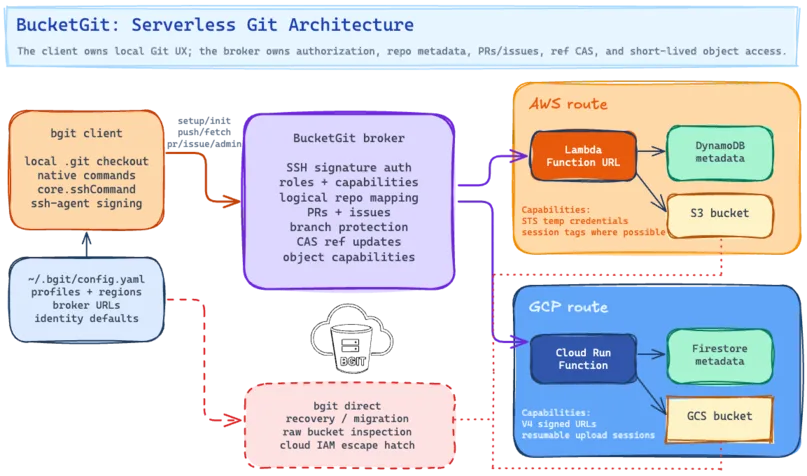
bgit keeps normal Git checkouts on disk while storing
repository objects and refs directly in GCS or S3. Access is
brokered with SSH keys, roles, pull requests, issues, branch
protection, and short-lived object-transfer capabilities.
git clone https://github.com/bucketgit/bgit.git
cd bgit
go build -o bgit .brew tap bucketgit/bgit
brew install bgitSetup
bgit setup discovers GCP and AWS profiles, lets you
choose regions, imports owner SSH keys, deploys or updates the
broker, and stores profile metadata in
~/.bgit/config.yaml.
bgit setup
# Choose cloud profiles, regions, owner keys,
# and global name/email.bgit setup profile create --provider gcp work
bgit setup profile create --provider aws workbgit init --noninteractive \
--repo app \
--profile work.europe-west1
bgit push --profile work --region europe-west1bgit setup
bgit config --local user.name "Ada Lovelace"
bgit config --local user.email ada@example.combgit whoami
bgit whoami --all
bgit repos minebgit direct help
bgit direct clone gs://bucket/path/app.git
bgit direct clone s3://bucket/path/app.gitCreate A Repository
bgit init configures a standard .git
checkout, a flat logical repository name, a broker profile, native Git
SSH transport, and repository identity. The broker maps logical
names to physical buckets and prefixes.
mkdir app
cd app
bgit init
echo "# App" > README.md
bgit add README.md
bgit commit -m "Initial commit"
bgit pushbgit init --noninteractive \
--repo app \
--profile work.eu-west-1
bgit add -A
bgit commit -m "Initial commit"
bgit pushSSH Bridge And Web UI
bgit setup provisions or discovers a small broker,
imports owner SSH public keys, and records broker profiles. Native
Git fetch and push then use bgit as the SSH transport
while repository data remains in GCS or S3.
bgit setup
bgit init
git remote -v
git fetch
git pushbgit admin keys list
bgit admin keys add --user ada --role developer --key ~/.ssh/ada.pub
bgit admin keys import-github octocat --role triage
bgit admin protect add mainbgit web
open http://127.0.0.1:8042/
bgit web --local
bgit web --port 9000# Broker-owned ref updates use role checks,
# branch protection, and compare-and-swap.
bgit push
git push
# Emergency inspection and recovery
bgit direct helpBucketGit Web Interface Screenshots
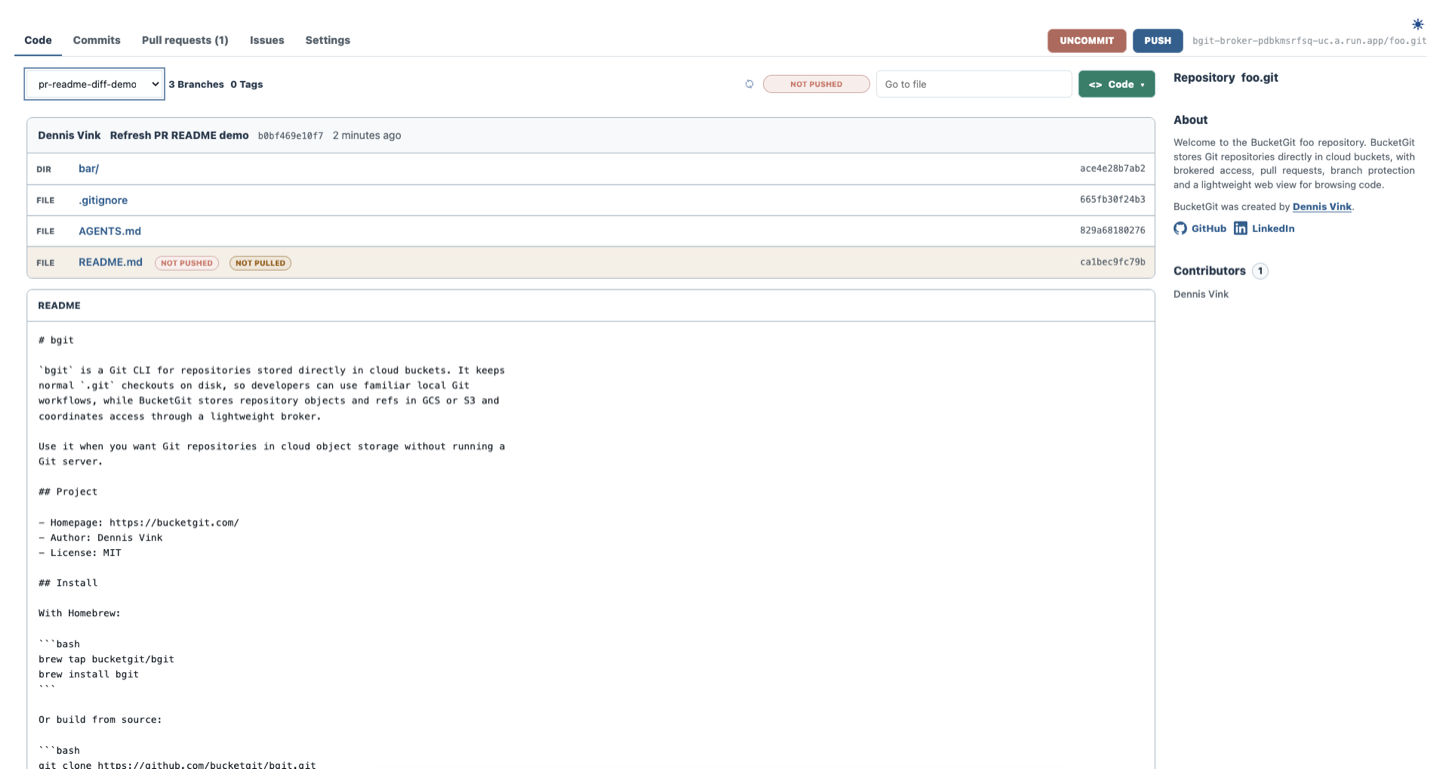
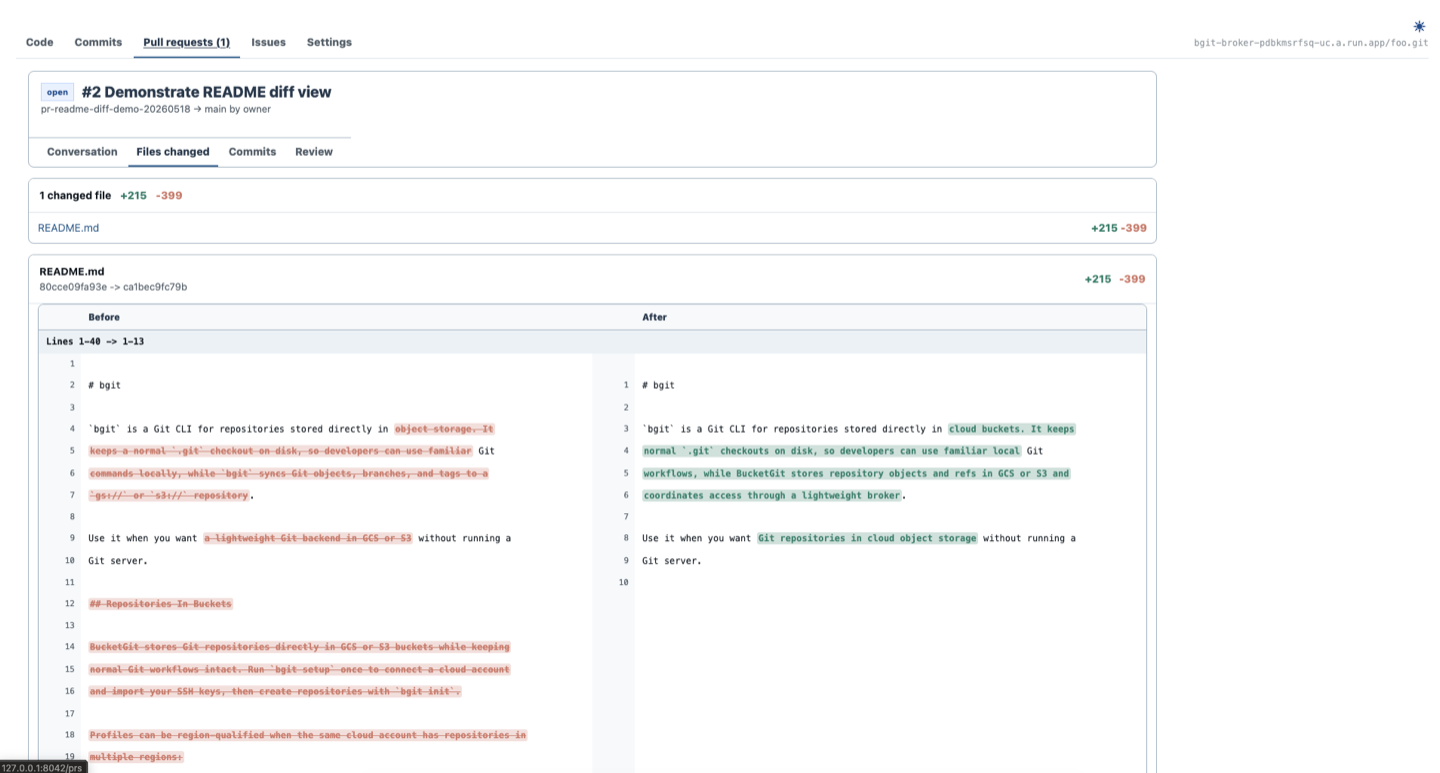
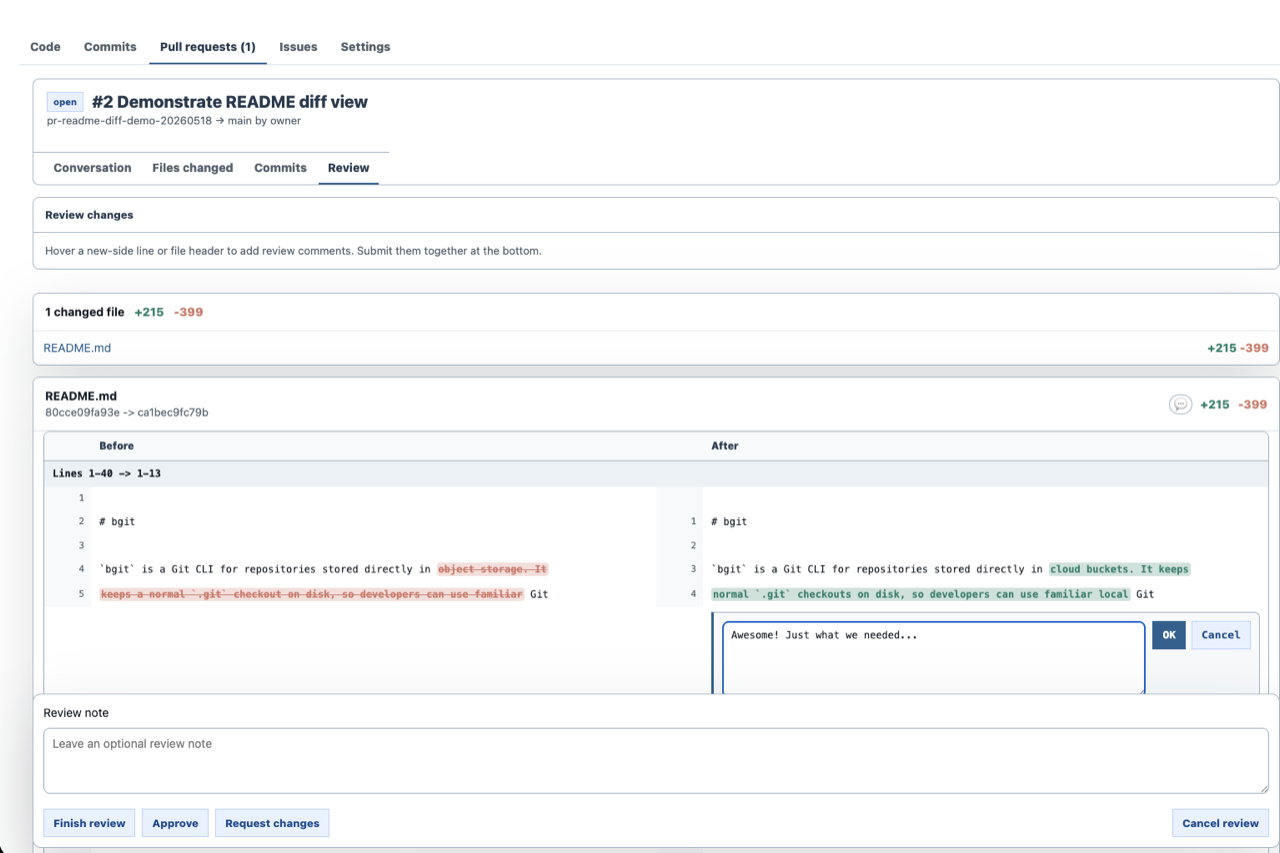
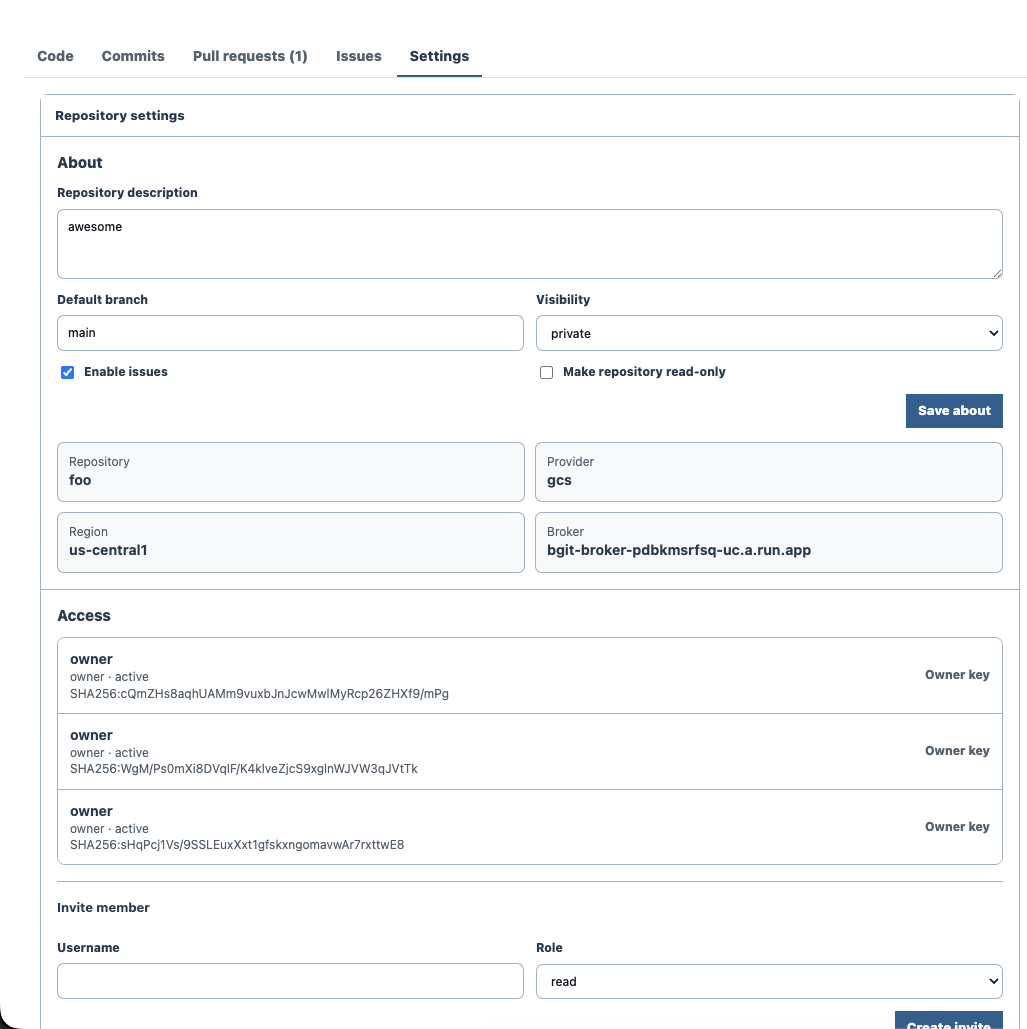
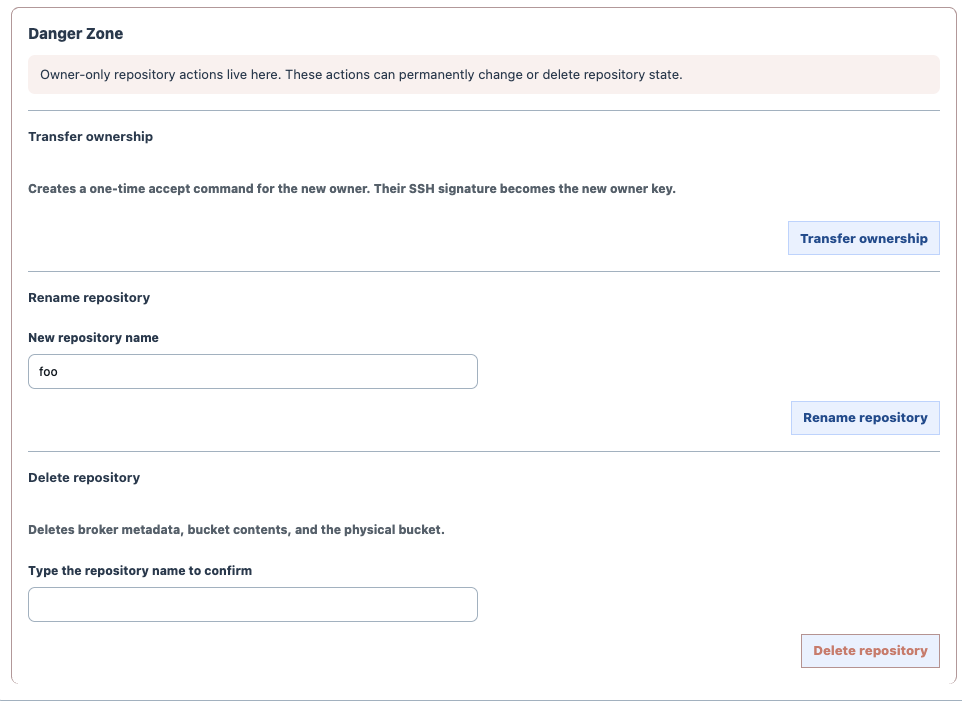
The local web UI renders repository state, pull requests, review comments, settings, and owner-only controls from the configured broker while preserving the normal Git checkout on disk.
Native CLI
Local commands are implemented by bgit for normal
checkout workflows. Remote commands use broker-issued object
transfer capabilities while protected ref updates remain broker
owned.
Stage, commit, inspect, and move through history without leaving the bgit CLI.
$ bgit status
M README.md
?? docs/setup.mdDocumentation
bgit creates normal .git checkouts locally
and stores remote Git objects and refs in GCS or S3 while the broker
handles identity, authorization, repository metadata, and protected ref
updates.
Install with Homebrew, download a release binary, or build from source.
brew tap bucketgit/bgit
brew install bgit
bgit --versiongit clone https://github.com/bucketgit/bgit.git
cd bgit
go build -o bgit .
The default workflow starts with bgit setup. It
discovers cloud profiles, lets you choose broker regions, imports
owner SSH keys, deploys or updates the broker, and writes
~/.bgit/config.yaml.
bgit setup
bgit setup profile create --provider gcp work
bgit setup profile create --provider aws work
Profiles are provider- and region-aware. If a profile has more
than one configured region, pass --region or use a
region-qualified profile name.
bgit init --noninteractive --repo app --profile work.europe-west1
bgit push --profile work --region europe-west1
Direct cloud credentials are still useful for initial setup,
broker upgrades, and recovery commands under bgit direct.
Day-to-day clone, fetch, pull, push, review, and web browsing use
SSH-key-signed broker access.
Normal repositories are flat logical names managed by the broker. The broker maps each logical repo to a physical bucket and prefix, creates missing buckets when allowed, and hides collision-resistant bucket suffixes from everyday commands.
bgit init
bgit init --noninteractive --repo app --profile work.eu-west-1
bgit clone https://broker.example.com/app.git ./app
bgit push
bgit clone and bgit init create standard
.git directories. bgit init also writes
core.sshCommand, so native Git fetch and push use the
BucketGit SSH bridge.
bgit status
bgit add -A
bgit commit -m "Update"
bgit diff
bgit show HEAD
bgit restore README.md
bgit reset --hard HEAD
bgit stash
bgit revert HEADbgit checkout -b feature/storage
bgit branch
bgit merge feature/storage
bgit tag v0.3.0
bgit push --tagsbgit grep broker
bgit blame README.md
bgit describe
bgit ls-files
bgit ls-tree -r HEAD
bgit archive HEAD > source.tar
bgit rev-parse HEADbgit fetch
bgit pull
bgit push
bgit push --delete feature
bgit ls-remote
bgit whoami
bgit repos mine
bgit setup deploys the broker and imports owner SSH
keys. bgit init configures a repository so standard
Git clients use bgit as the SSH command. The broker
stores logical repositories, SSH public keys, PRs, branch
protection, and compare-and-swap ref updates.
bgit setup
bgit init

git fetch
git push
bgit clone https://broker.example.com/app.git ./app
Key roles are owner, admin,
maintainer, developer,
triage, and read. Suspended keys are
rejected. If branch protection requires PRs, direct pushes to
protected refs are rejected unless owner/admin override is enabled.
Broker-mediated object transfer uses short-lived capabilities. AWS brokers can issue scoped STS credentials. GCP brokers issue V4 signed URLs and resumable upload sessions. Final ref updates stay broker-owned and are protected by role checks, branch rules, and compare-and-swap.
bgit admin keys list
bgit admin keys add --user ada --role developer --key ~/.ssh/ada.pub
bgit admin keys import-github octocat --role triage
bgit admin keys suspend KEY_OR_FINGERPRINT
bgit admin keys remove KEY_OR_FINGERPRINT
bgit web serves a local repository browser on
127.0.0.1:8042. By default it uses the repository's
broker configuration, seeds from local state for fast rendering,
then synchronizes remote state in the background.
bgit web
bgit web --port 9000
bgit web --local
The web UI includes branch and tag navigation, clone commands, file browsing, commit diffs, pull requests, issues, repo settings, capability-aware controls, local dirty/staged/unpushed state, and live refresh from the local daemon.
bgit admin manages broker users, roles, and branch
protection. Direct cloud IAM and bucket-policy recovery commands
live under bgit direct admin.
bgit admin keys list
bgit admin keys add --user ada --role developer --key ~/.ssh/ada.pub
bgit admin keys import-github octocat --role triage
bgit admin invite-user --broker https://broker.example.com --user ada --role developer app.git
bgit admin accept-invite CODE
bgit admin protect add main

bgit pr create --title "Add docs" --source feature --target main
bgit pr merge 1

bgit issue create "Missing docs" --body "The setup page needs examples."
bgit issue list
bgit issue comment 1 "I can take this."
bgit issue close 1
Roles are owner, admin,
maintainer, developer,
triage, and read. Protected branches can
require pull-request merges, with optional owner/admin override.
bgit admin repo visibility public
bgit admin repo visibility private
bgit admin repo readonly on
bgit admin repo readonly off
bgit admin repo issues on
bgit admin repo issues off
bgit admin repo rename new-name
bgit admin repo delete --yesbgit admin confirm-ownership-transfer --broker https://broker.example.com app.git
bgit admin accept-ownership-transfer CODE
bgit admin cancel-ownership-transfer --broker https://broker.example.com app.gitbgit direct help
bgit direct clone gs://bucket/path/app.git
bgit direct clone s3://bucket/path/app.git
bgit direct admin grant-read user:dev@example.com
rebase, LFS, submodules, worktrees, server-side
hooks, credential helpers, and repository maintenance commands
such as gc, fsck, repack,
and prune are not implemented. Local merge,
cherry-pick, revert, blame, and diff support covers practical
day-to-day workflows, but does not aim to be a complete
reimplementation of every Git porcelain edge case. The SSH bridge
implements the native Git fetch/push protocol used by normal Git
clients for BucketGit repositories.